
-
-
Recent posts:
- We’re Back: Scaling the Latam Climate Ecosystem
- The Last Sunset of 2025 and My Predictions for the New Year
- My 2025 Reading List
- Global economic outlooks for 2026 from leading investment banks
- Startup Equity & Dilution: What’s Normal in 2025?
- Mi charla con IT Masters sobre el ecosistema emprendedor en México
- Remembering Jane Goodall, a Titan of Conservation and Climate 🐒
- Join Dalus, NVIDIA, Stripe & Google Cloud to Talk the Future of AI
Popular posts:
- We’re Back: Scaling the Latam Climate Ecosystem
- Comentario sobre bitcoins
- ¿Cuál debe ser el crecimiento de un Startup?
- La e-entrevista: Vincent Speranza, Endeavor México
- e-entrevista: Marc Segura, Play Business
- La e-entrevista: Jimena Pardo y Diego Solórzano, Carrot
- ¿Cuál puede ser la valuación de Easy Taxi?
- e-entrevista con Daniel Mizrahi, Propeler
¿Se acabo el “hype” del app Yo?
 Hace algunos meses escribí mi primer post de este blog, sobre la app Yo, que había levantado capital de forma muy rápida, a pesar de tener una funcionalidad muy limitada (ver el post original aquí). En su momento argumenté que ese no era capital inteligente, sino que solo estaba motivado por el “hype” – lo de moda muy temporal – alrededor de la subida repentina en los downloads del app. También tuve un intercambio de posts y tweets con Santiago Rodríguez sobre esto.
Ayer vi un articulo que actualiza sobre lo que a pasado con el app en Slate (leerlo aquí). Aparentemente ha pasado lo que yo predecía. El interés por el app ha descendido bruscamente, como lo muestra el ranking en el AppleStore:
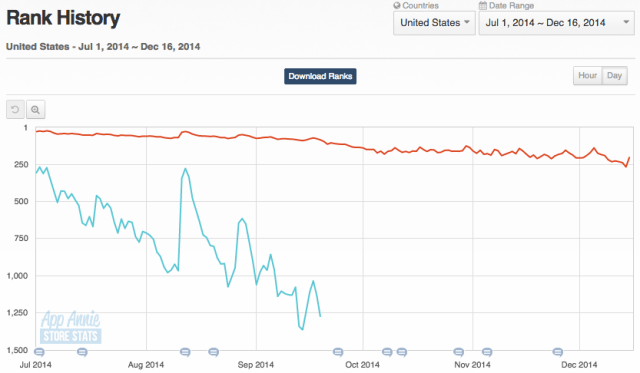
Azul: ranking general; Roja: ranking en categoria de social networks – Source: App Annie
El app ya no figura en el total general y esta alrededor del puesto 250 en la categoría de social networks donde hay pocos apps (estos son números para el AppleStore de USA). Es decir, ya muy pocos usuarios están bajando el app, por lo que claramente pocos lo están usando. Si el uso fuera activo, esos usuarios traerían nuevos usuarios por el efecto de network, pero no se esta dando esa tendencia. Era predecible que los usuarios dejaran de usar la app dada la casi nula funcionalidad una vez que pasara la novedad.
La compañía sigue viva por el dinero que levantó y obviamente están tratando de encontrar un uso y un modelo de negocios para sobrevivir. Me sospecho que las probabilidades que eso pase son bajas. Además si lo logran, creo que se enfrentaran a nuevas apps que han surgido, que también son simples pero ofrecen algo mas de funcionalidad que Yo.
Reitero mi conclusión anterior que esa inversión en Yo no era capital inteligente.
The mobile opportunity in Mexico

Image courtesy of sakhorn38 at FreeDigitalPhotos.net
There is a huge opportunity for entrepreneurs targeting the mobile market in Mexico today. The Mexican government enacted a key reform of the regulatory environment for the telecom sector in June 2013. This was a long awaited change. The telecom sector has been and still is controlled by one dominant company – America Movil, which controls 80% of fixed lines and 70% of mobile lines in the country. America Movil is controlled by Mr. Slim, who is always in the top three richest persons in the world. When Mexico is in position #67 in GDP per capita according to the World Bank.
This quasi “monopoly” has had perverse consequences for Mexico. The OECD estimates that 1.8% of GDP is lost every year due to this concentration. Telecom services have low penetration and higher prices than almost all other countries in the OECD.
America Movil controls 67% of the revenues of the sector, but invests only 33% of the total investment dollars. Another shocking statistic is that it only invests $10 dollars per user in Mexico, while it invests around $44 dollars per user in other Latin American countries including Brazil where it also operates. It takes advantage of their dominant position in Mexico to underinvest.
The good news is that the reform enacted will reduce the dominancy of America Movil and incentivize competition in the sector. Mobile penetration should increase and prices should decrease. 4G deployment should increase. Also broadband speed should increase from current relatively slow levels.
Despite this concentration the penetration of smartphones has been growing rapidly. It is a misconception to think that smartphone penetration is low. Most of the Internet companies I talk with in Mexico receive 50%-60% of their traffic from mobile devices already. Most web companies should be developing responsive design sites (an approach to design websites that provide an optimal viewing experience – easy reading and navigation with a minimum of resizing, panning, and scrolling – across a wide range of devices) and some should be thinking about developing their own apps to provide an even better user experience.
Mexico has 102 million mobile lines – an 85.4% penetration of total population – at the third quarter of 2014. 43% have a smartphone; that is 44 million people. However only 49% have a data plan; the rest uses Wi-Fi for internet and data access. The following chart shows the amazing evolution of smartphone penetration in the last six years:

Source: The Competitive Intelligence Unit S.C.
The ciu estimates that 7 out of 10 mobile lines will have a smartphone at the end of 2015. That is a huge opportunity for all entrepreneurs – a growing market of Internet users that will have more frequent access and also fastest access.
The positive changes generated by the reforms will create more opportunities as the market of mobile users will increase even more rapidly. The opportunity for mobile entrepreneurs developing tailored products is huge in Mexico.
Posted in Actualidad, Ecosistema, English
Tagged mexico, mobile opportunity, telecom
Leave a comment
Mexico in the Making
Great article in the Huffington Post – one of the leading online new media – on what is happening in the entrepreneurial ecosystem in Mexico, specially Mexico City. I was interviewed for the article and quoted there.
Mexico in the Making: The Emerging Tech and Entrepreneurship Community
Posted in Actualidad, Ecosistema, English, Entrevistas
Tagged huffington post, mexico
Leave a comment
Colombia, promising Tech Hub in Latam
Great article on the Colombian entrepreneurial ecosystem by my friend Conrad Egusa, published in TechCrunch. Thanks for mentioning me, Conrad.
Colombia Is One Of Latin America’s Most Promising New Tech Hubs
Great story on guerrilla marketing
I want to share this great post on guerrilla marketing. Really entertaining read and inspiring for B2C entrepreneurs.
How an Illegal Gambling Website Became the King of Marketing
Posted in Curiosidades, English, Startups
Tagged goldenpalace.com, guerrilla marketing
Leave a comment
TiZKKA – a team with a global fashion dream
 I want to share with you the story of TiZKKA, a great app by a team I have been mentoring for some months now. TiZKKA is being launched in Mexico and other Spanish-speaking countries in Latin America this week. Before continue reading you should download it to your iPhone here so you can see what I’m talking about (a version for android will be ready soon).
 TiZKKA wants to be your personal stylist. The app lets you connect with stylist and fashion experts that could provide real time feedback on your fashion choices. This is being done with a social network feeling, so you can share looks with your followers and review, like and comment on the looks of the people you follow.
TiZKKA was created and founded by Gabriel Roizner and Nathan Schorr, both young Uruguayan entrepreneurs and both serial entrepreneurs.
They saw that despite the huge interest in fashion, there was no practical ways of creating a back and forth communication between users and stylists and fashion experts. Also, people were using some general social networks like instagram to share their fashion looks and request feedback from others. Instagram clearly wasn’t designed and optimized for that usage providing then a regular user experience.
Gabriel and Nathan decided that Brazil should be their starting market and called the app Roupologia (science of clothing in Portuguese). Roupologia was launched in beta in March 2014 only in Portuguese and slowly stylists and users came onboard in Brazil. The first months were used to improve the user experience and iron out bugs. The company was run in a bootstrapping mode and most of the user acquisition was organic (which means that almost no money was spent on marketing).
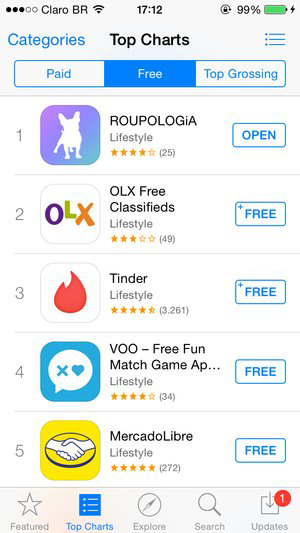 The first breakthroughs came in August this year, when Roupologia had its official launch. Then different fashion and style websites and fashion bloggers wrote notes saying that Roupologia was “a must have app for fashion lovers”. New users registrations grew by 20x in a few days and then stabilized on a 4x rate compared to before the launch. Roupologia made it to the number one spot on the lifestyle ranking of the App Store in Brazil for several days, above apps like Tinder or MercadoLibre.
Encouraged by this, the entrepreneurs and their advisors, including me, saw a global opportunity. Quickly the app was modified to localize to any country and English and Spanish versions were introduced (other languages could follow in the near term). The team decided to look for a more universal name, easier to pronounce and write, and TiZKKA was selected.
As of today, TiZKKA has more than 330 stylists – fashion bloggers, personal stylists, image consultants, makeup artists, hairstylists, and fashion designers – onboard and has created a loyal base of more than 25k users of which 50% use it recurrently every month. Weekly user growth is at 7%. Since the launch in August, users have had more than 200k sessions viewing more than 6 million looks!
And if you wonder about monetization, brands are actively calling the team interested in partnering and promoting their products on TiZKKA. The team believes that with the new fully global version released this week that growth could explode. They know fashion lovers are everywhere, and today they do not have a comparable app.
I think this a great story so far and a great example of the global view that Latam and emerging markets digital entrepreneurs should have. In this case, very driven and smart entrepreneurs with a great idea decided from the begging to tackle a 200 million people market – Brazil – rather than start in their less than 4 million people market – Uruguay. When in less than six months they got market validation in Brazil that users loved their app, they decided to think globally and started preparing the product accordingly. They are focusing on a Spanish-speaking Latam launch this week but other regions will follow.
I hope you enjoy TiZKKA and become a recurrent user. It is an amazing product! Download TiZKKA here.
Do not hesitate to contact the TiZKKA team (or me) if you are a stylist, fashion blogger or brand that want to be on the app. Interested investors with fashion experience are also welcome.
Posted in English, Startups
Tagged fashion, global startup, Roupologia, social network, TiZKKA
Leave a comment
Full house for Kevin O’Leary conference at INCmty
Fun to see how the place fills up.
A summary of Kevin O’Leary presentation here. For sure controversial for many people.
Posted in Curiosidades, English, Inversiones
Tagged INCmty, Kevin O'Leary, time lapse
Leave a comment
Quote of the day @ #DFTechSummit
“The 50% rule: spend 50% of your time on product and 50% on traction.”
Similar to my view that traction – attracting increasing number of users and/or clients – is fundamental for startups and should be the focus of the entrepreneur.
Quote of the day at INCmty
“The average human life expectancy increases one year every ten years.
It is likely that a baby that will live 150 years thanks to health science advances has already been born today.”
Posted in Actualidad, Curiosidades, English
Tagged 150 years old baby, Juan Enriquez Cabot, life expectancy
Leave a comment
