
When a startup raises capital, it is always a delicate balancing act. You have the valuation of the startup on one side and the size of the round on the other. This tension is what determines dilution.
Simply put, dilution is the percentage of ownership that goes to your new investors, and by definition, it is the percentage that everyone else’s slice of the pie shrinks.
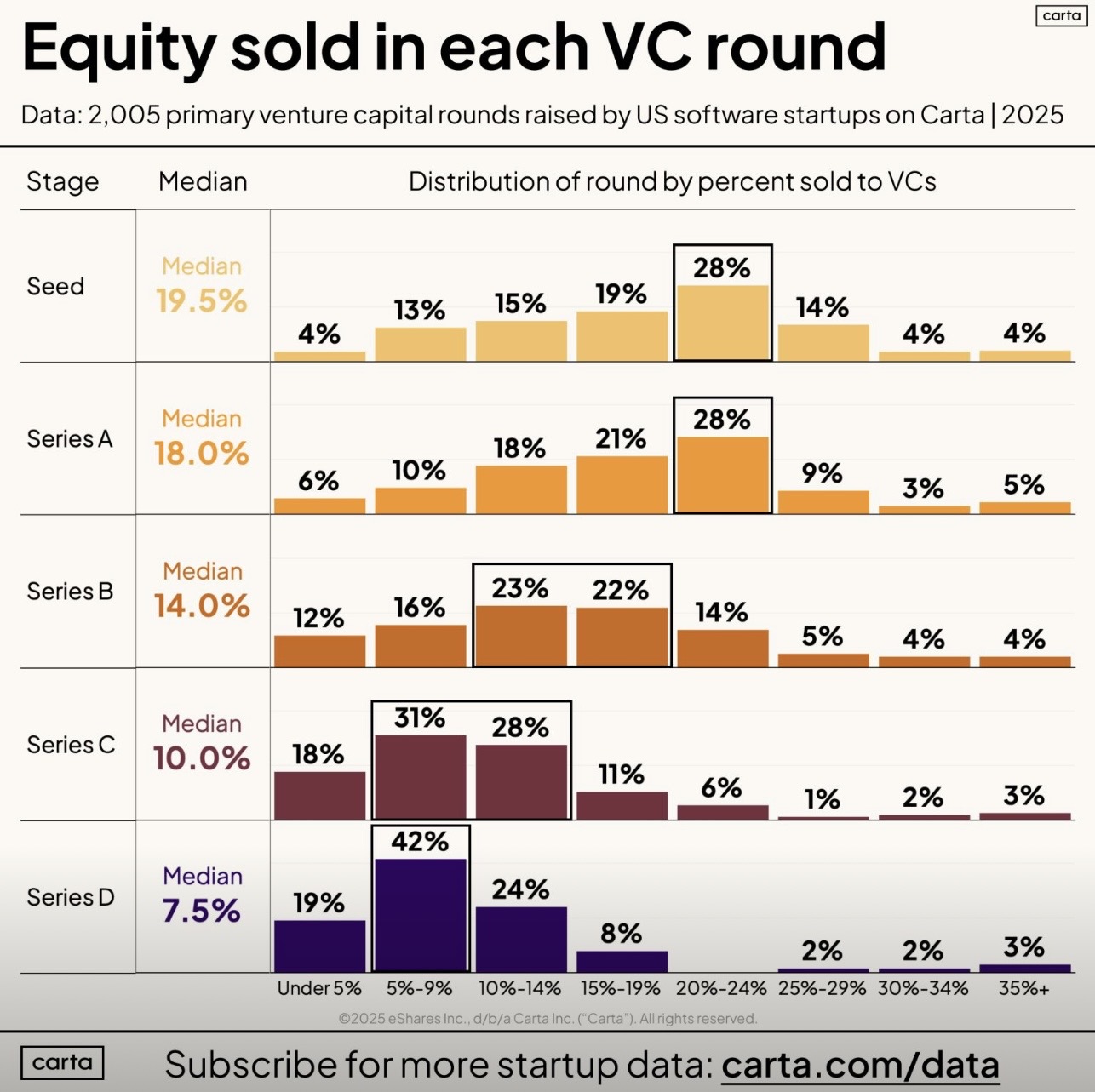
I came across this chart from Carta, which breaks down the average equity sold (dilution) in 2025 by round stage. It paints a very clear picture of the current fundraising environment. While this data reflects the US market, it serves as a critical benchmark for us in Latin America. Even though our check sizes and valuations are often lower in absolute terms, the dilution targets—the slice of the pie you sell—should remain similar.
Here are some key takeaways from the data:
The “normal” range is higher than before. In every stage, we see a bell curve distribution. For Seed and Series A rounds, the most common outcome is selling between 20% and 24% of the company (this occurred in 28% of the rounds analyzed).
The median dilution sits at roughly 19.5% for Seed and 18% for Series A. This is higher dilution than we saw during the exuberance of 2021. It reflects the current market reality: capital is more expensive, and investors are demanding more ownership for their risk.
Notice the far right of the chart, specifically in the Seed, Series A, and even Series B stages. Nearly 10% of startups sold over 30% of their company in a single round. That is a dangerous zone to be in, making future fundraising mathematically difficult.
Dilution decreases as startups mature. As companies move from Series B to D, the percentage of equity sold drops significantly. By Series D, the median dilution is just 7.5%.
This happens because companies (hopefully) become more capital-efficient. They need to raise less cash proportionally to their valuation. Essentially, a mature company should have a valuation that captures enough value to minimize the “cost” of new capital.
The reality for founders. It is worth highlighting the math here. After stacking the dilution from a Seed round and a Series A, and factoring in the creation of employee option pools, founders (along with friends, family, early angels, and potentially pre-seed investors) will likely hold around 50% of the startup post-Series A.
You can read more on the status of the venture capital market in Latam here.
