
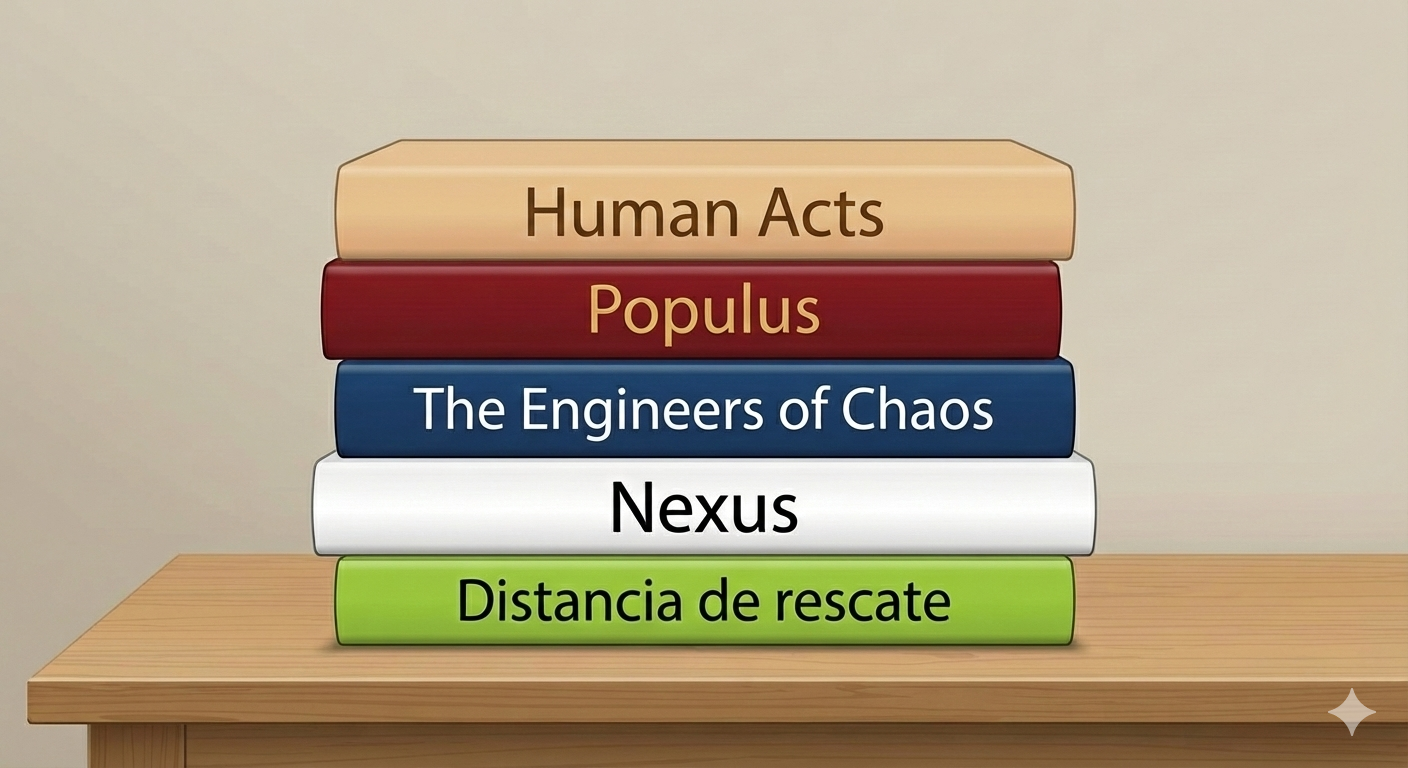
It’s been a few months since my last reading update, and as we wrap up 2025, I wanted to share a fresh batch of books that have sparked my curiosity.
If you’ve followed my blog, you know I’m drawn to topics that explain why the world works the way it does, whether through the lens of history, technology, economics, or the complexities of human behavior. The non-fiction titles in this list reflect that mix, ranging from AI and populism to the daily life of the Roman Empire.
In fiction, I have been drawn to emerging Latin American writers and global masters, including several recent Nobel Prize winners.
Below, you’ll find my latest reads, followed by a recap of the books I recommended earlier this year.
🆕 New Additions
Non-Fiction
- AI 2027. This isn’t a proper book, but rather a collection of scenarios regarding the future of AI. It reads like a science fiction novel, yet it’s grounded in the very real possibilities of where the technology is heading. If you want to be aware of what is happening in the AI field right now, and where it might be in two years, this is very worth your time. I wrote a dedicated blog post some months ago about this report. 🤖
- Populus: Living and Dying in Wealth and Poverty by Guy de la Bédoyère. I love books that describe how people lived their daily lives in other ages. It is fascinating to see how much technology has improved, while human behavior much less so. This book focuses on the Roman Empire. It is striking to see how many concepts from our society, including politics, democracy, government, market economies, and capitalism, were mainstream more than 2,000 years ago. Shockingly, this was also a society based on slavery, huge class differences, and colonization. These are concepts that humanity has sadly repeated ever since. 🇮🇹
- Nexus by Yuval Harari. It is a pleasure to read another book from Yuval Harari. He has an amazing way of explaining why institutions, societies, and humanity have evolved and work the way they do. In this book, he focuses on information networks. If you haven’t read his previous books, especially Sapiens, add them to the top of your list.
- The Engineers of Chaos by Giuliano da Empoli. I recently discovered this writer, and I’m including two of his recent books in this list, both of which are very relevant to the global political landscape. This one is probably the best explanation I have read so far on the rise of populism in the world. Da Empoli dissects how modern spin doctors and data scientists have rewritten the rules of politics, turning chaos into a strategy. A must-read if you’re trying to make sense of the current political climate.
- The Wizard of the Kremlin by Giuliano da Empoli. A fictionalized political analysis that dives deep into the Russian psyche. It explains the country’s history, the phenomenon of Putin, and the popular support that backs him. If you want to understand the current geopolitical landscape, this offers a unique, almost psychological perspective. 🇷🇺
- Breakneck: China’s Quest to Engineer the Future by Dan Wang. An interesting read on how the “nation-building” mentality differs between China and the USA. In my opinion, only the first half of the book is worth it. The rest becomes a mix of autobiographical details of little relevance and the author’s frustration with how China handled the Covid pandemic. 🇨🇳
Fiction
- Fever Dream (Distancia de rescate) by Samanta Schweblin. An interesting psychological horror story by this Argentine author. It’s a short novel, but intense. Schweblin has a knack for creating an atmosphere of dread that keeps you reading. 🇦🇷
- Human Acts by Han Kang. The most emblematic book by the recent winner of the Nobel Prize in Literature. It tells a heartbreaking story set during the dictatorship in South Korea, which for me is a period of history I knew nothing about. I still have mixed feelings about the author’s style, but the narrative is absorbing. 🇰🇷
The remaining books I read in 2025 that I had already recommended in previous posts:
Non-Fiction
- Nuclear War: A Scenario by Annie Jacobsen. A detailed, sobering, and frankly terrifying account of how the nuclear weapons infrastructure works. It reminds us that the power to unleash global destruction lies in the hands of very few individuals. ☢️
- The Revenge of the Tipping Point by Malcolm Gladwell. A continuation of his classic. It explores social pandemics and their tipping points through recent real-world examples. A great, entertaining read.
- Taming Silicon Valley by Gary F. Marcus. A manifesto arguing against the unregulated development of AI by big tech. While I don’t agree with all his concerns, many of his points on regulation and rapid evolution are valid.
- A Field Guide to the Apocalypse by Athena Aktipis. A darkly humorous yet insightful guide on preparing for challenging times, blending science with wit.
- The Psychology of Money by Morgan Housel. A useful philosophy on how to think about money, expenses, and investments, offering lessons on wealth, greed, and happiness.
Fiction
- Maniac by Benjamin Labatut. Historical fiction at its best. It weaves together the story of John von Neumann and the development of the atomic bomb and the first computer. The final section on AlphaGo felt somewhat weak and disconnected from the main story.
- Flights by Olga Tokarczuk. A unique collection of stories loosely connected by the theme of travel. Her style is captivating. It is a great introduction to this Nobel laureate. 🇵🇱
- A Sunny Place for Shady People by Mariana Enríquez. A collection of contemporary short horror stories. I love her casual voice describing everyday life twisted by unsettling elements. 🇦🇷
- The Vegetarian by Han Kang. The first book I read from this recent Korean Nobel winner. A strange novel. Beautiful prose, though I didn’t connect deeply with the story. Still worth reading given her recent recognition. 🇰🇷
- Wanderers by Chuck Wendig. A massive sci-fi novel about mysterious sleepwalkers. I didn’t love the writing style, but the story itself is very interesting.
As always, I’d love to hear what you are reading. If you pick up any of these, or have a recommendation that challenges my thinking, let me know. Happy reading! 📚
If you want to dig deeper into my library, you can check out all my previous book recommendations here.

Lees muchas autoras, qué buena! Hemos leído varios en común, gracias por las recos de libros
LikeLiked by 1 person