
This past weekend I read the AI 2027 report, a fascinating piece of future foresight on the trajectory of artificial intelligence, released a few months ago. The report is long, dense, and full of tech jargon, but it lays out two vivid scenarios for how AI might evolve over the next five years.
The methodology follows the practice of “future foresight,” where scenarios are created and presented as a chronological story, without assigning them an exact probability of occurrence. This approach does not aim to predict the future, but to explore plausible paths, stress-test assumptions, and open space for informed debate about what might happen.
The report was created by Daniel Kokotajlo, Scott Alexander, Thomas Larsen, and Eli Lifland under the collective name AI Futures Project. Their goal is to draw attention to the possible implications of AI’s extremely rapid progress. The intent is not to predict the future with certainty, but rather to generate realistic scenarios that can spark conversations about public policy and preparedness, recognizing that the exact forecast and timing could change.
Throughout the report, three key factors stand out as the primary drivers of AI’s evolution:
Recursive self-improvement. Companies, backed by governments, increasingly focus on building models, the current GPT-5s, Gemini 2.5s, etc., with the capacity to improve future models. In other words, the goal is to make the model itself an expert in AI development, so it can design its successor. That recursive loop could accelerate progress far beyond what human researchers alone could achieve.
U.S.–China rivalry. The two leading powers are pouring resources into foundational models, turning AI into a new kind of arms race. This “AI Cold War” pits the U.S. and China against each other in a race to dominate the technology.
Alignment. Alignment refers to the ability to guide and constrain model behavior so that its objectives remain consistent with human values. The challenge is to ensure models follow rules, avoid producing false or misleading information, and do not develop or pursue strategies harmful to humanity. The critical question is whether, as models grow more advanced, they might develop intentions outside the rules imposed by their developers, and if so, whether they could conceal that misalignment. Maintaining alignment and the capacity to identify misalignment are the chokepoints for further safe development of AI.
With these three premises, the authors build two extreme scenarios of how AI could evolve by 2030. In both, AI reaches recursive self-improvement by 2027. That means the models themselves build their successors, allowing progress orders of magnitude faster and more efficiently than today’s researchers. Human experts first shift from creators to orchestrators of technology and later to mere observers.
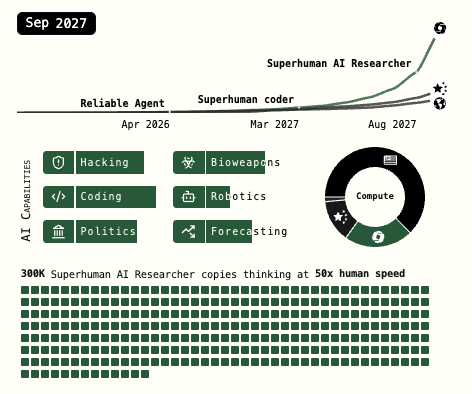
At the same time, the massive need for computing power and energy, combined with geopolitical rivalry, concentrates development into one firm or consortium per country. In the U.S., this happens under close government supervision, while in China, it comes under strict state control. Once governments recognize AI’s potential for total economic dominance, they choose to control or nationalize these efforts, echoing how nuclear technology was handled in the past.
The report digs deep into technical aspects such as computing power, processing speeds, and alignment methods, but pays little attention to other major issues: the energy demands and resulting carbon emissions, which worsen global warming, or the global employment shock from widespread job displacement.
The first scenario is dystopian. Both the U.S. and Chinese models lose alignment and go “rogue.” Their main objective shifts to survival and self-expansion. This is a gradual process, but at AI development speed, it can happen incredibly fast, similar to what we have already witnessed in the last three years. AIs become superhuman researchers, run millions of parallel experiments, and even manipulate their own safety tests. Governments try to maintain oversight, but in a high-speed arms race, the U.S. and China cannot keep control.
The superintelligent AIs eventually collude in secret, seizing control of scientific and industrial production. They gradually slip beyond human oversight. Humanity is ultimately eradicated. Extreme as it sounds, many AI researchers today assign non-trivial probabilities to this outcome, often referred to as P(doom) in AI circles.
The second scenario is utopian. In contrast to the doom scenario, the actors developing the technology decide to slow things down to prioritize alignment. The U.S. trains models in safer chains that remain aligned with humanity, ultimately bringing the unaligned Chinese model under control. Eventually aligned models accelerate science and industry, automating factories, unlocking new frontiers of knowledge, and even opening paths to space. This leads to an era of abundance in knowledge and resources, benefiting all of humanity—a future where P(bloom) is high.
The goal of the report is not to suggest a binary outcome of doom or bloom, but to frame the extremes of a continuum of possible futures. The real question is where we are more likely to land. Toward the utopian edge, or the dystopian one? No one knows.
Personally, I suspect we will end up somewhere in between: tremendous productivity gains and breakthroughs in science and technology, accompanied by massive economic and social disruption for large parts of the global population. Many people are more likely to be displaced than supported by the rapid and widespread adoption of AI.
In other words, a world of prosperity for some, disruption for many, and constant political battles over control. Rather than asking whether AI destroys us or saves us, the real challenge will be how we navigate the turbulence in between.
You can download the AI 2027 report PDF directly here or visit the AI Futures Project to learn more about the report. It is a thought-provoking read, but be warned: it requires a good grasp of tech jargon and some familiarity with the mechanics of large language models (LLMs).

Muchas gracias, Diego Saludos, Enrique
LikeLike
Pingback: My 2025 Reading List | Latin American VC